


The Albany Museum of Art Breaks Ground at Its Future Downtown Home
Wednesday, May 20th, 2026
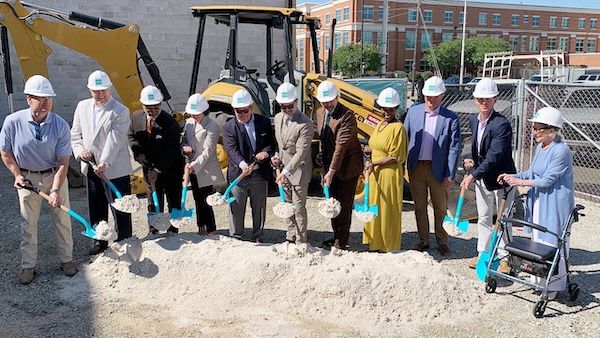
In the gentle shadow of the two-story brick building in downtown Albany that once housed a thriving department store, officials with the Albany Museum of Art and city and county governments gathered with a crowd of approximately 170 well-wishers under a bright, azure Monday sky to break ground at what will be the museum’s new home.
“This morning is more than an event. It is about a vision, a partnership, and the many people who have helped bring us to this moment,” said R. Ripley Bell, Jr., president of the Albany Museum of Art Board of Trustees and chairman of the Campaign Committee that is raising funds for the $35 million adaptive use project.
“Today is an important step as we move into the public phase of this campaign,” Bell said. “We’re incredibly proud of how far we have come, and we’re grateful to everyone who has helped us get here. But we also know great community projects are built on conversation, one partnership, and, yes, one donation at a time.”
Announced funding for the project includes Historic Tax Credits, $4 million in SPLOST funds from the city of Albany, $3 million in SPLOST funds from Dougherty County, a $3 million donation from the Bunzl Foundation, and $1 million in private donations.
The transformation of the 1970s-era department store at the corner of North Washington Street and West Broad Avenue into the new Albany Museum of Art is expected to take 24 months. Once completed, the museum will have 58,000 square feet of usable space for art exhibitions, educational programming, a family area, storage and protection of its collection, event space, and offices. In addition, the new AMA will add a store and café.
During the construction downtown, the museum will continue to offer a full slate of art exhibitions, programming, and events at its current site at 311 Meadowlark Drive, adjacent to the Albany State University’s West Campus.
Bell thanked AMA Executive Director Andrew James Wulf, Ph.D., for his leadership and work in making the project a reality, and acknowledged the vital roles that the Board of Trustees, Capital Campaign Committee, Albany and Dougherty County public officials, the Robert N. Brooks family who donated the building, business leaders, and philanthropic organizations, including the McCormack Foundation and the Jame M. Barnett, Jr. Foundation, and community supporters have played in the progress of the project.
“I’d like to thank everyone here today for believing in the importance of art and culture in Southwest Georgia. Together, we are building something that will serve and inspire generations to come,” he said.
In the invocation at the beginning of the ceremony, the Rev. Lorenzo Heard, Chairman of the Dougherty County Commission, gave thanks “for those who can see beyond now and can see beyond to what could be, to now envision an embracing, a thriving, innovative, empowering, educating, showcase museum in downtown Albany, Georgia.”
“May we never forget what can happen when we work together, value our own uniquenesses, respect each other’s contributions, and collaborate for the greater good,” the Rev. Heard said. “May this be a place where citizens and visitors, young and old, family and friends, rich and poor, educated and not so educated, come together to be informed, inspired, enlightened, enriched, and empowered for many years to come.”
Albany Mayor Bo Dorough said the AMA relocation is one of three downtown undertakings characterized in the city’s master plan as “catalytic projects.” Already attracting 20,000 visitors a year and with expectations that its downtown site will swell that number, Dorough said the new museum will be “an essential component of narrowing” the gap between what downtown Albany is, and “what we want and need it to be.”
“The museum on this corner will be the heart of an arts district,” the mayor said. “Its proximity to the Municipal Auditorium, the little theater, the Arts Council, and Albany State will serve to both integrate and enhance the programs and events of each of these cultural institutions. I applaud the museum for making this bold step, which will enrich and educate children, students, and adults throughout Southwest Georgia for generations to come.”
Dorough said he would like to see collaborations develop between the downtown AMA and nearby cultural arts centers. He also wants to see a star walk outside the museum.
“I propose that the sidewalks on the north and west sides of the property be embedded with stars recognizing natives of Dougherty and surrounding counties who are successful artists, musicians, poets, and authors,” he said. “In addition to (Albany native) Ray Charles, there are numerous musicians who should be honored, remembered, and celebrated.”
The downtown site will be “totally transformed” over the next 24 months, Jake Reese, president of LRA Constructors, the firm that will construct the new museum, said. The outdoor area where the ceremony took place will be transformed into a sculpture garden, he noted.
“The adaptive reuse project blends protecting the historic character of the property with modern design elements that will create a first-class facility that will serve the Albany area for generations to come,” Reese said. “The design is state-of-the-art, offering finishes and systems that will create a unique visitor experience. The design team at DLR Group and the museum have created an incredible vision, which the construction team, along with our friends at Aaron & Clements, look forward to bringing to life.”
DLR Group, a global design company, designed the new museum and has been involved with the project since shortly after the building was donated to the AMA by the Brooks family. Aaron & Clements, a Columbus, Ga., firm, is working with LRA Constructors as the museum’s representative in all aspects of the project delivery process.
Wulf opened his remarks with a special thank-you to former AMA Technical Director Bruce Campbell, who worked tirelessly on the relocation project from its inception until he officially concluded that role last December. He also welcomed DLR Group Cultural+Performing Arts Design Leader Monika Smith and architect Juan S. Rodriguez Laverde, who traveled from Washington, D.C., to attend the event.
Later in his remarks, Wulf also acknowledged “the Mvskoke and Lower Creek peoples on whose ancestral homelands we gather, as well as the surrounding diverse Indigenous peoples who have made their home in Georgia, such as the Cherokee, the Apalachee, the Yuchi, the Alabama, the Hitchiti, and the Guale peoples.”
Noting that the downtown site has already created memories with Southwest Georgia residents who shopped there when it was a Belk Department Store, Wulf said, “This is a historic morning, and what makes it especially meaningful is we’re standing before a building that already belongs to the story of the city. And now it is about to begin a new life. That is what we are here to celebrate.
“We are not simply building something new. We are transforming something familiar, reimagining this concrete shell as a 21st-century museum for Albany, this region, and for generations to come. There is something powerful about that. It says that renewal is possible. It says that imagination has a place in the heart of our city.”
The groundbreaking “represents years of planning, generosity, partnership, persistence, and faith—faith in this museum, faith in the city, and faith in what the arts can do for a community,” he said.
“The museum we create here will be a place for exhibitions, education, and our permanent collection,” Wulf said. “It will be a place for schoolchildren, families, artists, and visitors. But just as importantly, it will be a place for people to gather, a place of welcome, curiosity, reflection, and connection. That matters because a museum is not just a building. At its best, it is one of the few public places where people can come together to slow down, to look closely, to learn, and to imagine something larger than themselves. That is the kind of place we are creating here.”
Wulf said the AMA is deeply grateful to the many supporters of the project and the Capital Campaign Committee, “whose belief in this museum helped bring us to this day.” Before the group donned construction hats and took bright blue shovels to an area of white sand for the symbolic groundbreaking ceremony, he reminded the audience that there is still work to do.
“Today is not the end of the journey,” Wulf said. “It is the beginning of a new phase, a visible phase, an exciting phase, and a transformational one. A building that once served one purpose will now serve another. A downtown landmark will become a home for art. This community will gain a new place to gather, to learn, and to be inspired. That is a wonderful thing.
“Now, let’s begin.”

